OUR SERVICES / SELF-EMPLOYED
Run your own business? Secure the home loan you need with the help of self-employed home loan specialists.
Self-employed home loans have always been our bread and butter. They don’t need to be hard (although sometimes, they can be!). The regular lending guidelines apply, with vastly different options on income verification. As experienced finance brokers for self employed borrowers, we’ve seen so many of these that it’s hard to surprise us anymore.
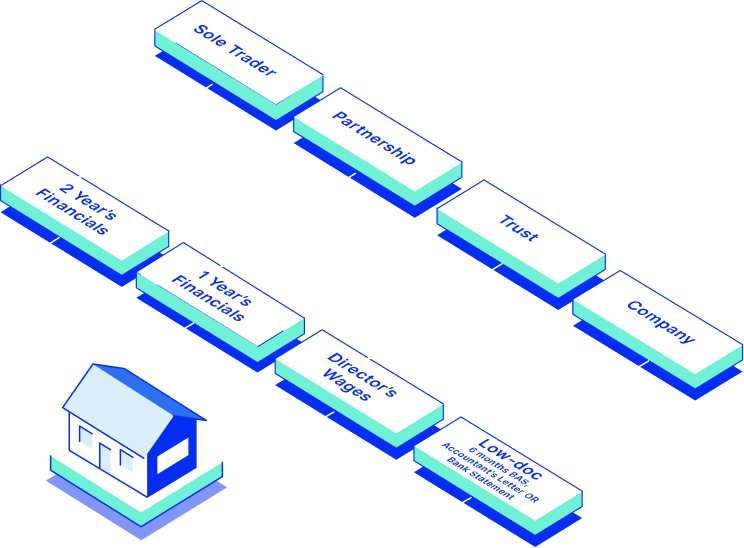
There are a number of different structures that may apply, but here’s an overview and how they will affect your lending:
Shares can be held beneficially in your own name, or on behalf of a trust. Here are a few cool policies we can use to help with income:
You and the business are one-and-the-same. This is generally quite simple – take your net business income from your tax return and we’re golden. Beyond that, we can still apply add-backs (depreciation, interest etc.).
There is typically no need for accountant-prepared financials; however, there is opportunity to actually ignore business debt with a major bank for a sole trader, if we obtain an accountant’s letter to confirm that the personal debt (all sole trader debt is technically personal debt) is for business use and has been expensed as such in your tax return.
Often (but less commonly) used as a trading entity, usually distributing excess profits to a bucket company when trading well. All the above policies mentioned under “company” apply here – although sometimes they’re a little trickier, if the trustee is an individual.
We do lend to these structures, hence they are noted here, but we wouldn’t consider them usual structures for self-employed individuals.
Low-doc loans, or even no-doc loans in the private space (70% LVR & rates at RBA + 6%), are available and come with a surprising amount of nuances when you get to the nitty gritty. Our preferred method for income is BAS or an accountant’s letter because bank statements are never straightforward, but let’s look at the options:
Most lenders will look at your BAS and run a calculation, then average over 12 months.
The calculation: G1 (total sales) less 1B * 11 (owed by ATO multiplied by 11 to get GST inclusive expenses) less W1 (wages paid). This generally works, but there are a few ways various lenders can end up with better or worse figures:
Low-doc loans are okay up to 90% LVR (RBA + 6.2%), but generally we get more flexibility and much more palatable rates at 80% LVR (RBA + 2.75%). Considering full-doc loans generally only get as low as RBA + 1.7%, the rate isn’t too bad depending on your goals. We can do a range of low-doc loans, including:
Technically, we can do 1 month’s ABN, but that’s in very rare and specific circumstances. We wouldn’t recommend this, however, as you’ll get charged a small fortune for the pleasure and we’ll be looking at your historical PAYG earnings.
Likewise, we can do 6 month ABNs, but they’re still really expensive at around RBA + 4.2% (75% LVR).
We have had 3–month ABNs approved with major banks in the right circumstances. If you’ve recently swapped to an ABN and are contracting exclusively to your previous employer, we may have a solution for you. We’ll need a strong application and 80% LVR.
Most of what we do is 12 months or higher ABN, where things get more flexible: